

10 business time-saving hacks so you can consistently promote your small business

Nadin Thomson

Written by Nadin Thomson

6 June 2024

business time saving hacks to consistently-market your small business


Running a micro business is super rewarding, but it’s also hard work. You’re often doing everything – from making the product or delivering the service to marketing and admin.

In this blog post, I am sharing some tips on how busy entrepreneurs can find the time to do it all without heading for burnout.

I have asked a few people I highly regard and know who do a fantastic job marketing their business. Their time saving tips are included below.

 1 – The number 1 tool that most small business owners don’t use to consistently market their business – Your diary

Your diary is your biggest time saving hack as a business owner and can help you with your time management. You must use a diary and write down the things you want to do.

I have tried and failed for many years finding a way to “do it all” and I kept falling off the wagon! Again and again. Until my business coach introduced me to the concept of “default diary”.

Even when he introduced it to me, it still took me two years to develop a default diary that worked for me and my business.

A default diary uses the method of time blocking. You block out certain periods of time in your diary which are set aside to work on similar tasks.

What is a default diary?

A default diary is simply an A4 sheet of paper or file where you create a table with 5 (or 7) days. You then split your day into blocks that work for your business. This could be 30-minute, 1-hour blocks or 4-hour blocks – whatever works for you.

Here’s what an empty default diary looks like:

default diary

Then, you start scheduling your regular tasks. Make a list of the tasks you usually work on every week, for example:

  • Client work
  • Administrative tasks / bookkeeping / invoices
  • Marketing / blogging / social media
  • Emails
  • Breaks

Then you fill in the blocks with the tasks you created.

The aim of the default diary is to create a consistent plan where you put in your regular tasks into your diary and you then respect that plan!

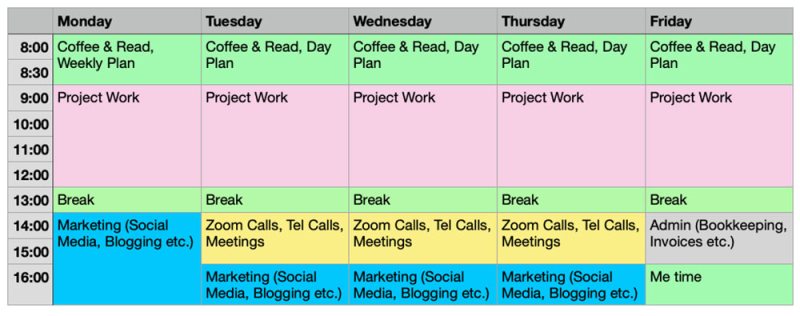
I’ve tried many different versions, but I had to come up with one that also worked with my “body and brain”. I know I am not a morning person, but I work well in the mornings on my own. This means that all my client work is done in the mornings – when I am not disrupted.

I don’t take calls or zoom meetings before 2 PM.

My default diary is on my desk – it’s a print out of what I do and when. Here’s an example:

default diary example

What if something comes up, but your time is blocked out with project work?

Your default diary is not set in stone! However, it would be best if you honoured the time slots and not quickly amend them because a friend called for a coffee meeting.

If you get a client enquiry and they can only speak to you in the morning, you can choose if you allow them to eat into your productivity time if it’s a crucial client.

Most customers are OK with finding a time that works for you. Imagine you’re a photographer working on a project for a client between 10 and 2 PM. Would you allow another client to “gate crash” your project work? Probably not! So please be strict with your time.

An easy way to do this is by simply sending out a calendar link to your customers, and they can pick a convenient time for you and them. They will only be able to book in your available time. Calendly works well for this.

Develop a morning routine as part of your default diary

If your business allows to have the “same morning” every weekday, it’s useful to develop a morning routine that sets you up for the day.

Don’t start your day with doom-scrolling on your mobile in bed. Get up, have a cuppa, read a book, cuddle the cat or exercise.

My morning routine consists of coffee, cat and reading in Winter and weeding in Summer (gardening!). This clears my head in the morning.

Use your default diary to plan your week, and use your calendar to set deadlines.

Use your regular paper calendar or one of the many available productivity apps (ClickUp, Monday, etc.)  to schedule appointments and deadlines. If you’re working on a big project, break it down into steps and add these as deadlines to your calendar. By using an actual calendar or an app, you can see what’s happening in a particular week, and you’re less likely to forget to complete an important task.

Another productivity hack is to front-load your weekly calendar and work on your urgent tasks first. Please ensure every week contains a time slot to work on your overall business goal. You can also automate tasks if your business has many routine tasks every week.

Remember to take regular breaks to re-energise.

ashley leeds

I asked Ashley Leeds, the 15-minute guy, what his take was on doing marketing consistently. He replied with: “Do 15 minutes every day!” He also said to save time is to “get systems in place and automate things”. The default diary is a system you can use, and you can use Calendly to automate your meeting bookings.

2 – Stop marketing on channels that are not right for your business

There are too many social media platforms to choose from. You may look at your competitors, who are “smashing” it across all the different platforms. However, you don’t know their setup in the background! Do they outsource this? Do they have a department doing the social media posting for them?

Look at your target customers and find out where they spend time and where they would look for your products and services. Not every platform suits every business, and there’s no blanket way of saying, “you must be on TikTok to be successful” (for example).

Simply enter in Google “Social Media demographics” and you will find lots of interesting statistics like this to start your research.

ann-maree

Ann-Maree Morrison MBE said: “Don’t market on channels that are not right for your business, do your research.”

3 – Batch your marketing activities and schedule social media posts

Another great tip by Ann-Maree Morrison MBE: “Set aside an hour a week to schedule all your posts for the coming week or two.” She also said, “ I wish I had scheduled my social media posts via planning software with a set theme instead of just doing them ad hoc at the start.”

This regular time for social media posts can become part of your default diary.

There are many different options for social media post planning available, such as Buffer, Planoly, Hootsuite, etc. They all have various plans available for budget-conscious entrepreneurs.

You can always replenish money. You can never replenish your time! Invest in systems that save you time to work ON your business more.

4 – Outsource your social media posts

mette bailey

Mette Bailey, Freja Designer Dressmaking in Edinburgh wrote about her experience:

I dabbled with social media for years and spent time on different channels. I would get carried away and spend far too much time on one channel, only to abandon it soon after, and something else would get my attention; that is precisely what not to do.

Today, I am growing my channels; my main channel is Facebook. It gets so much slack, but you need to check your stats, and Facebook, for me, is just solid. Last month, my reach was 160.000 views on Facebook, with the same kind of posts on Instagram attracting only 15.000, but everyone wants to grow on Instagram; you need to know what works for you.

I would suggest to be consistent. I got growth and conversion when I was consistent; I now post every day. I schedule stuff for every day. If something is current and I want to post, I can move things around, but I know something is scheduled. I am lucky to have a super marketing intern, and she schedules it all. When she is not here, I write the posts and get a VA to schedule them. That is the best use of my time.

Outsourcing your social media content creation can save you lots of time – procrastinating over it and creating it!

Ask around in your industry – who do they use? You can look for a virtual assistant online or use a website like Fivver. You could also post on LinkedIn or Facebook that you’re looking for someone to do the work for you. You will be amazed by the responses!

You might say that you don’t have the funds to do this at the moment, but trust me, delegating tasks you might not be good at or don’t enjoy is a beautiful feeling. Keep an eye on what they create; don’t hand it over and forget! Ask for regular reports and check what is working and what isn’t!

Dr Lisa Stephen said: “Be wary of a total do-it-yourself approach because it often costs much more time and money than you can imagine, and it is usually ineffective.

If you have the budget to hire trusted subject matter experts for the areas where you expect to get the best results, hire them because there is typically no way that you can produce the same results they can deliver.

So, for example, if you use meta ads, hiring a true meta expert usually saves you the time and money of investing in a subpar do-it-yourself strategy. If you use experts wisely, you can save money by doing things on your own in areas that are less likely to result in sales. You can create social media posts and pay an expert to handle your meta ads.

5 – Find an accountability partner or group

Running your own business can feel lonely, mainly if you are used to being in a team, and different tasks are shared across other team members.

Most industries have paid and free networking or support groups – online and offline – that run regular (online) events.

Depending on your personality type, you might enjoy chatting with several people in a group, or – if you’re more like me – I prefer a business coach that kicks ass regularly. I meet my coach online once a month, and they check in to see if I have worked on the things I said I would. If I didn’t, I am “told off,” we discuss why I didn’t do them and how I can overcome this hurdle.

It took me years to find a business coach that works for me. You don’t want to hire someone that says lovely things about how amazing you are in business but one that challenges you regularly, pushes you out of your comfort zone and helps you out of the labyrinth if you need it.

6 – Become an expert

We often start out as a generic supplier of a certain service. However, over time, you will notice that you don’t enjoy working with a certain type of client or you no longer want to provide a certain type of product or service.

As a small business owner, we can react super quickly! We can change our offering today! Decide what’s the one thing you keep going back to in your business and then knuckle down on it! Learn EVERYTHING there is to know about it and become known as the “SEO Girl with the cats”, or “the cake designer who does amazing disney cakes”, or “the VA who helps plumbers with their admin”.

Your speciality will find you and you will find your speciality. Over time, you will learn what the market reacts to when you post content.

For me, it was SEO and web design. In 2020, when everyone was furloughed, baked sourdough bread and walked the field for a 100th time, I was doing a post graduate diploma in digital marketing. It was a 1-year super intensive course that covered all aspects of digital marketing, including SEO, website, advertising, social media, and so on. During the whole course, I devoured the SEO content!

stuart mason

Stuart Mason, Junction Twenty, said that finding a niche and becoming an absolute expert in that field can be an absolute game changer for a small business.

7 – Set Goals and make a plan to achieve them

As a small business owner, you must understand the meaning of “goal”, “plan”, “strategy”, and “tactics”. 

This sounds very corporate and boring, and you might think you don’t need this as a small business owner. However, big businesses are successful because of using these!

A goal is a measurable number of something you want to achieve. For example, one of your goals could be to have five new clients per month.

A good strategy outlines how you will achieve your goal of five new clients per month. You will look at different methods to achieve your goal and plan how to achieve it.

You then need a plan to follow your strategy. This will outline in which time frame you will do which task. A good plan tells you what you need to do, when you need to do it, and how you’ll do it.

Tactics are the specific actions that help you stick to your plan.

lisa

Dr Lisa Stephen: Think carefully about your goals, objectives and action steps and make a detailed plan.

8 – Be clear about your target customer

Having a target customer is super important. I remember when I started as a web designer, I would take on anybody willing to pay me for my services. 

Over time, I niched down, and now I specialise in websites with a local service offering. I don’t build ecommerce websites, and I don’t build websites on platforms I am not familiar with. 

Developing your target customer is a relatively easy thing to do, but it does take time, and the picture becomes more precise over time. I’ve created a simple exercise you can do to find out who your target customer is. 

You can download this here.  

Knowing who your ideal customer is helps you save time as you will understand where they hang out, i.e. which platform. You can then focus on this platform and don’t have to waste time creating content for platforms where they don’t spend time. 

lisa

Lisa replied to what she wishes she had done years ago:

Narrowing down my niche and clearly identifying my customer. You might not think of this as time-saving but it is! When you are very focused on what you are selling and the characteristics of who is buying then everything you produce is much more on target. I wasted a lot of time producing blogs and social media content that did not help me sell and I will not reuse this material. I could have saved myself a lot of time and stress if I had taken the time to narrow things down earlier on. Now I have an efficient system that works well!

9 – Stop context-switching!

Context switching is one of the biggest time-saps and will diminish your productivity. Context-switching means that you’re trying to do three or more things simultaneously. You’re quickly switching contexts between different tasks. This is counter-productive and slows you down. I used to do this all the time and still do sometimes! I have a massive second screen on my desk, which shows my emails, my calendar and a messenger. It’s an easy distraction and tempting to “quickly check” what’s happening while working on something entirely different. Statistics have shown that simply by switching to another task, you will need up to 10 minutes to get back into the original task you were working on. While doing the research, they also found that over 40% of people who regularly do context-switching feel much more fatigued. What’s the solution? Please be sure to batch your tasks if you can.
  • Could you combine small tasks and complete them in one go?
  • Could you combine repetitive tasks into one work session?
  • Work on one thing until it’s finished, then start the next.
The average person is interrupted 31.6 times/day. Cut down on interruptions and work on one context at a time.

10 – Switch off all notifications & avoid unnecessary meetings

This is a no-brainer and one of the biggest time saving hacks, but very few people do it! Switch off your notifications! ALL OF THEM! You decide when to check messages – when you’ve got the brain space to do so, and not when your phone decides to interrupt your flow.
  • Remove the little red bubbles on your phone indicating a new message.
  • Remove the sound your phone makes when a WhatsApp message is coming in.
  • Switch off your email programme on your computer and only check it a couple of times a day!
There’s never been a fire in an inbox! And remember, someone else’s lack of planning is not your emergency! Pre-Covid, we were all on the road substantially more. The pandemic forced us to meet online, and we can now save substantial travel time. Have you ever seen the meme “This meeting should’ve been an email!” – this is true for many meetings. Use the time saved not travelling either for yourself (exercise, read, take a break) or working on your business.  

Now it’s your turn – to add your regular marketing tasks to your diary

Things you can outsource as a small business owner
What are the elements of a luxury wedding supplier website
business time saving hacks to consistently-market your small business
The top 15 mistakes when starting a business
What can happen when you find an image online and upload it to your website Rights Control Letter
How to optimise my website for all different locations
Nadin Thomson

Hi, I'm Nadin Thomson

I started building websites as a hobby in 1999 and launched my web design business in 2004. With over 20 years of experience, I’ve helped businesses of all sizes create and improve their online presence. I’ve also worked as a photographer in Scotland for 15+ years, with most clients finding me through Google thanks to my ongoing SEO efforts. I hold a university business degree and a postgraduate diploma in digital marketing. More about me here.